Australian Crop Update – Week 29, 2025
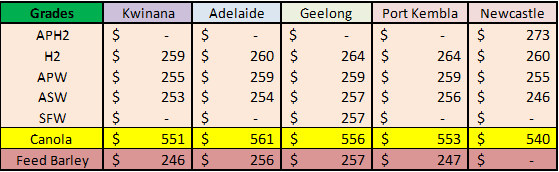
2024-25 New Season - USD FOB Indications
NEW CROP PRICES ARE BASED ON TRACK BID/OFFER SPREAD PLUS ACCUMULATION & FOBBING COSTS AND ARE NOT FOB PRICE INDICATIONS.
Australian Grains Market Update
The Australian domestic grain markets finished last week mixed but with a little more activity. Global inputs were negative, with CBOT wheat down 2% for the week while corn futures tumbled 9%. Canadian canola futures tumbled 5%. Global cash markets were less volatile with Russian FOB wheat nominally $1 higher. The AUD was 0.5% higher.
Old crop export shorts are still supporting wheat bids in New South Wales (NSW) and Western Australia (WA) and barley in WA. Current prices are seen as uncompetitive into export markets for bulk and containers. It’s hard work for the exporters and there is no sign of this changing in the near term with northern hemisphere crops coming off in line with or better than expectations. This was largely reflected in the USDA’s July WASDE on Friday night. Demand from Australia therefore remains consistent to the time of year with other global markets more competitive for the time being.
Australian Export Statistics Update:
Australia exported 862,783 metric tonnes (MT) of barley and 530,471MT of sorghum in May, according to the latest data from the Australian Bureau of Statistics. Feed barley saw May export totals of 727,647MT which was up 26%t from 575,838MT shipped in April, with China on 652,884MT being the biggest market.
May’s total sorghum exports were also up from April, posting a 33% rise. China was the main destination importing 483,133MT for May sorghum shipments with 23,110MT to Indonesia and 16,001MT to Kenya.
Export Stem & Ocean Freight Market Update:
Shipping stem additions have slowed in recent weeks in line with expectations. There was 326 thousand metric tonnes (KMT) of wheat added to the stem this week following 134KMT in the previous week. The four-week average prior to this was 420KMT. There was also 50KMT of barley and 30KMT of canola added to the stem in the past week.
The market witnessed a notable surge on the Panamax and Supramax markets, especially in the Atlantic basin, where an increase cargo activity from USG and ECSA caused the indexes to gain approximately 20% week-on-week as the tonnage supply tightened across the board. The CONT-MED markets welcomed the flow-on effect as we saw rates gain from Monday through the Friday. The Panamax sector in the Pacific is also benefitting off the back of the strength ex ECSA as many market players now had a viable option to ballast from India/SEAsia towards the Atlantic which caused the tonnage-vs-cargo ratio to sway into wwner’s favour. There were early sign of rates pushing upwards by end of the week in the Pacific but many believe this should gain pace over the next few days. The Supramax market in the Pacific has an underlying positive sentiment circulating as more demand from Far East/Nopac is entering in the market, while in Southeast Asia there has been a sudden push for Nickel Ore exports from Philippines to China. Tonnage is in limited supply so we expect rates to continue its upwards trajectory in the Pacific.
A notable watch on the market is the recent escalations in the Red Sea by the Houthis. Although there was still a limited number of owners willing to transit, we expect that list to shorten further as a result.
Australian Weather:
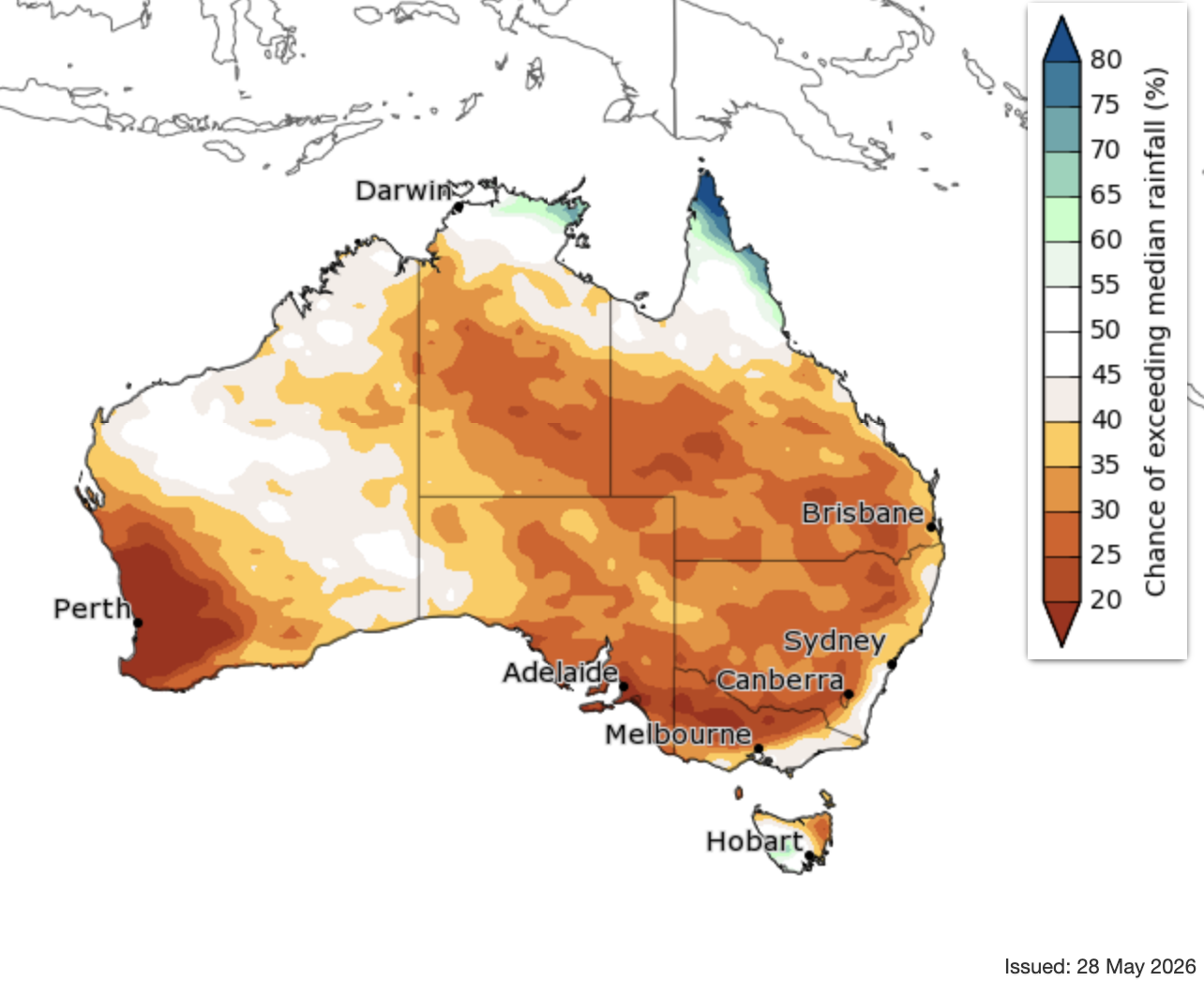
Weather forecasts offer more of the same this week in WA and South East Australia set to see a series of cold fronts offering showers and some rain and possibly some isolated rain in the northern areas of the east coast. Last week most of Victoria received 8-15mm. New South Wales received 4-10mm however it didn’t extend into the central west. South Australia enjoyed the best of last week’s rain with 15-45mm. WA also received beneficial rain, albeit patchy.
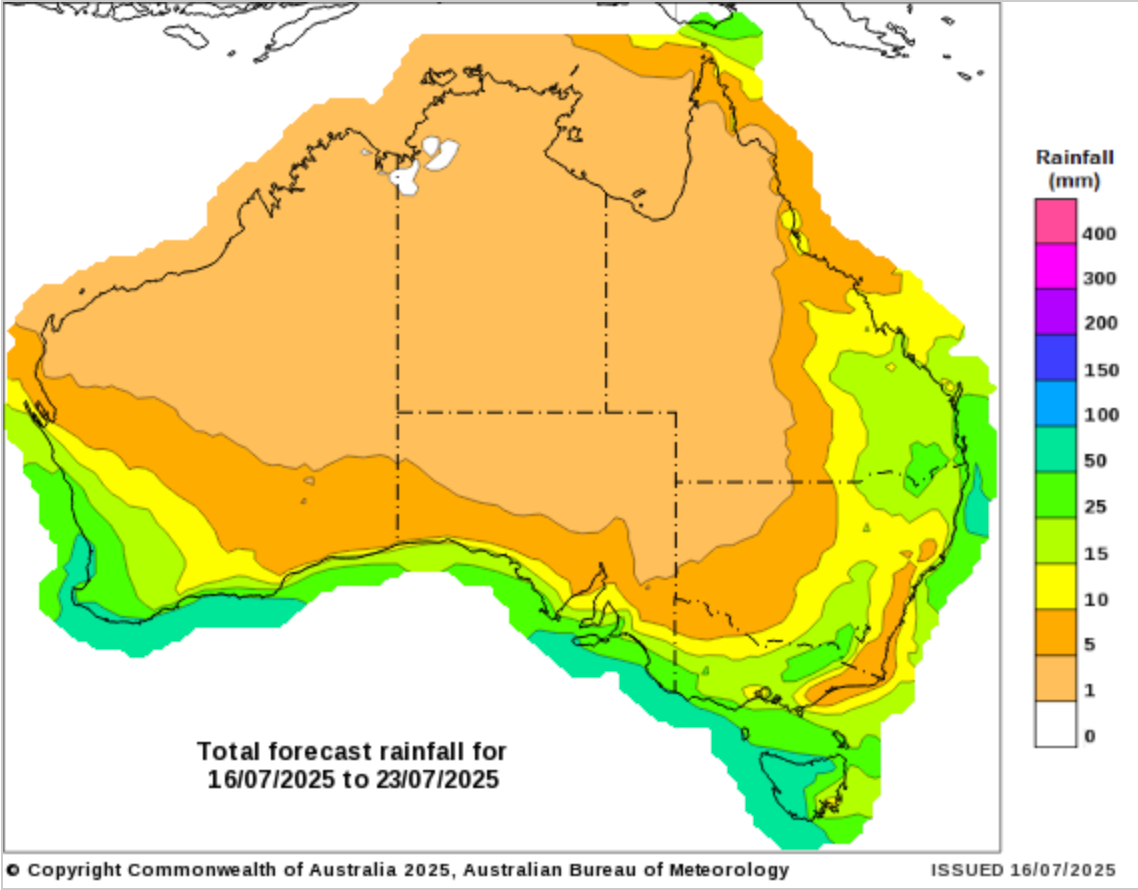
8 day forecast to 23 July 2025
http://www.bom.gov.au/
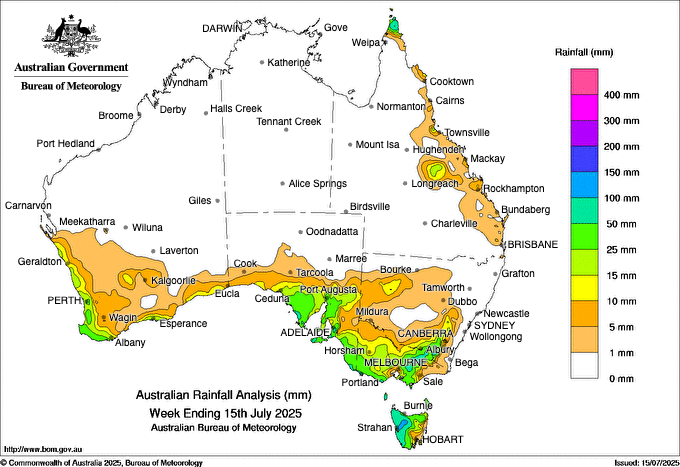
Weekly rainfall to 15 July 2025
http://www.bom.gov.au/
AUD/USD Currency Update:
Last week the Australian dollar (AUD) gained ground against the U.S. dollar, appreciating by approximately 0.7%. The AUD/USD pair opened the week around 0.6550, climbed to a high near 0.6597 on July 10, and closed slightly lower at around 0.6572 by Friday. The AUD was supported mid-week by stronger-than-expected Australian inflation data and encouraging economic signals from China, which boosted risk sentiment and lifted demand for the currency. However, the rally lost momentum toward the end of the week as the U.S. dollar regained strength following renewed trade tariff concerns and a more cautious global outlook. Despite the brief pullback, the AUD managed to hold most of its gains for the week, trading in a relatively tight range between 0.6491 and 0.6597. Looking ahead this week and the AUD/USD is expected to trade in a relatively narrow range, with slight bearish pressure as markets brace for an RBA rate cut and its ripples through global sentiment. Technical indicators show resistance around 0.6600.
Share This Article
Other articles you may like
Sign Up
Enter your email address below to sign up to the Basis Commodities newsletter.